Why Did Gov. Kehoe Keep Citizens, Legislators, and Media
in the Dark About AI Data Centers?
Did you see the news report on AI Data Centers? (Watch the attached report from Mark Maxwell.)
In the video, Governor Mike Kehoe declares that Missouri is “open for AI,” even as opposition to massive data centers continues to grow. The report cites a recent Gallup finding that roughly seven in ten Americans would oppose a data center being built in their own community.
Those concerns are not abstract. Residents are asking serious questions about:
-
Electricity demand and higher utility costs
-
Water consumption
-
Noise and light pollution
-
Strain on roads and infrastructure
-
Property rights and farmland
-
The loss of local control
Across Missouri, communities are pushing back against projects they believe have advanced with too little transparency and too little opportunity for meaningful public input. Data-center controversies are already dividing Republican leaders, energizing residents, and influencing local elections.
But the most troubling question is this:
Why were lawmakers and the public kept in the dark for so long?
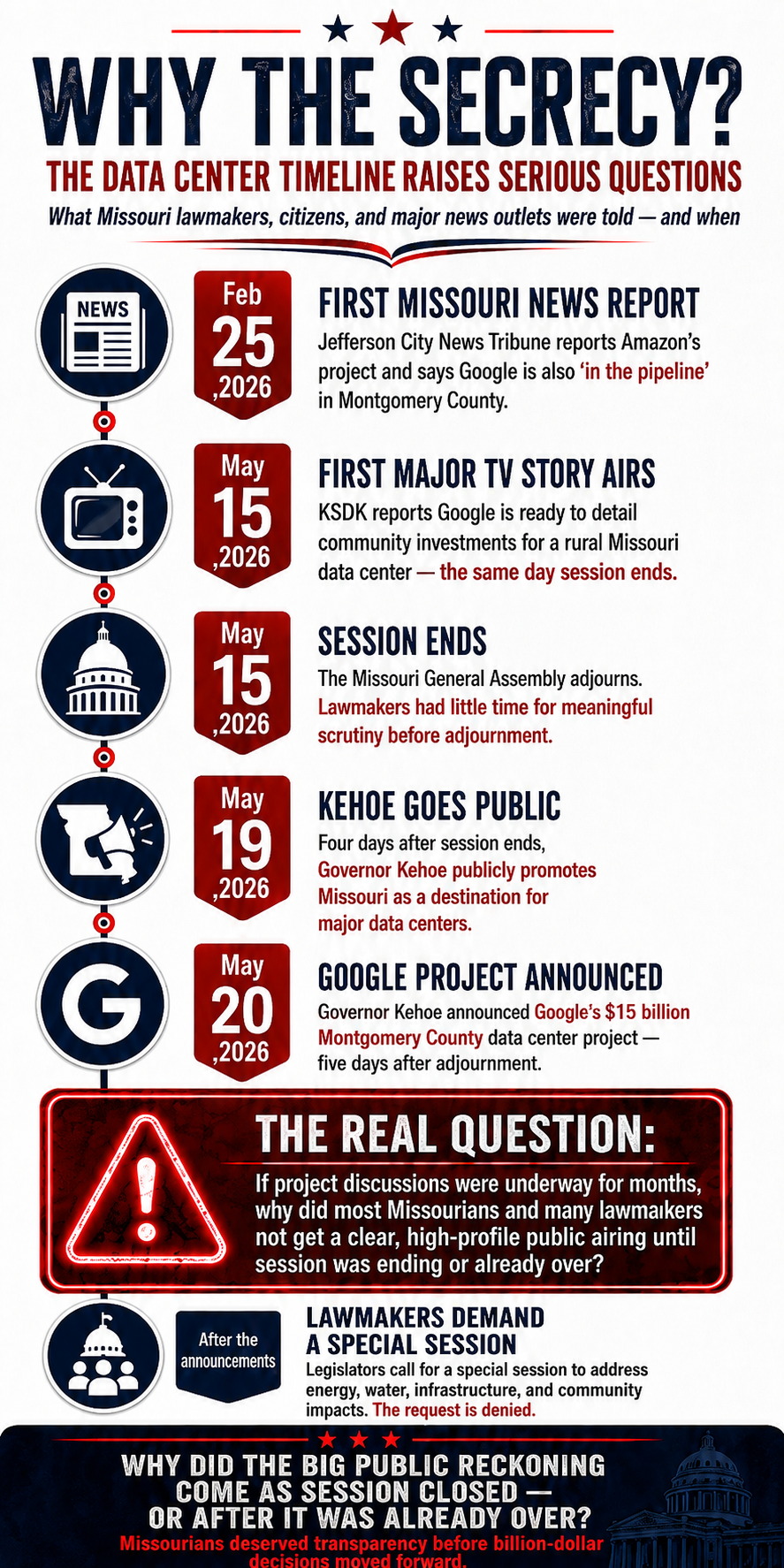
Governor Kehoe’s administration worked to attract large-scale data-center investments, yet many legislators, citizens, and major news organizations did not learn the full scope of these developments until the regular legislative session was ending or already over.
That timing left lawmakers with little meaningful opportunity to investigate the projects, debate safeguards, or pass protections before adjournment.
Take a close look at the accompanying timeline:
“Why the Secrecy?”
After the announcements became public, Republican lawmakers called on Governor Kehoe to convene a special session. They wanted the General Assembly to address the potential effects of data centers on Missouri’s:
-
Electric grid
-
Water supply
-
Roads and infrastructure
-
Data privacy
-
Property rights
-
Utility customers
-
Quality of life
They warned that Missouri should not wait until major decisions had become difficult—or impossible—to reverse.
Governor Kehoe refused to call the special session. His administration said the issue could wait until the next regular legislative session and maintained that many data-center decisions should remain with local officials.
But the central issue is bigger than whether Missouri permits data centers.
The real question is whether projects of this size, cost, and consequence should move forward before citizens know the full details, before lawmakers can provide oversight, and before protections are in place.
Missourians should not learn about billion-dollar projects only after the deals are already moving, the legislative session has ended, and their opportunity to demand safeguards has been narrowed.
Transparency MUST come before approval—NOT AFTER.

Data Centers
Threaten Communities

TRICIA BYRNES WORKS FOR MISSOURI
While Opponent...
Byrnes Takes ACTION!
Byrnes brings SOLUTIONS
✅Byrnes built a coalition of concerned lawmakers and pushed for a serious legislative response to the growing concerns surrounding data centers.
❌Her opponent, chose to pose for photo ops and political alignment with data center supporters.
✅Byrnes moved quickly after Governor Kehoe’s surprise May 20 announcement of Google’s hyperscale data center - that nights she began working with more than 20 fellow state representatives to push for a special session before Missourians were left to shoulder the consequences on their own.
❌Her opponent, toured events with the Governor, avoided addressing the growing concerns surrounding data centers, and drove around in an expensive parade float.
Tricia Byrnes Creates Paths to
PUBLIC ACCOUNTABILITY
✅Byrnes arranged for members of her Intergovernmental Affairs Committee to meet in September and begin examining the data-center
issue in a formal hearing process.
❌Her opponent, remained quiet about data centers, while accepting endorsements from the Governor and serving steak dinners to supporters. All the while telling voters he would "Cut the Bull" in Jefferson City.
✅Byrnes pushed forward and developed draft legislation so lawmakers could begin real work on transparency, oversight, and protections for Missouri communities.
❌Her opponent, said in an interview "Nothing can stop the mega site so make the best of it." - Cecil Hayden, Montgomery Couty - The Good, the Bad, the Ugly, June 19, 2026.

Community Concerns: Data Center Transparency
Listen to local families speak about the impact of the proposed data center on their daily lives and property values.

Key Arguments: Economic Stability vs. Special Interests
The legislative case for putting families first and ensuring that Missouri's future isn't sold to the highest bidder.

The proposed Deering Data Center project: A critical assessment of land use, community transparency, and long-term economic impact for Missouri families.
JOIN THE FIGHT FOR MISSOURI'S FUTURE
We need transparency, accountability, and strong leadership to protect our families. Sign up today to receive critical updates and learn how you can help Tricia Byrnes fight for our district.